New publication in Nature Metabolism with contribution from Panasyuk lab
An important collaborative study reveals how lysosomal signalling controls muscle growth
Panasyuk lab at INEM is proud to have contributed to a collaborative study published in Nature Metabolism, together with Karim Hnia’s team (Institute of Cardiovascular and Metabolic Diseases, Toulouse) and international partners. This work provides important new insight into how lysosomes regulate mTORC1 signalling and muscle growth, and advances our understanding of the mechanisms involved in muscle disease.
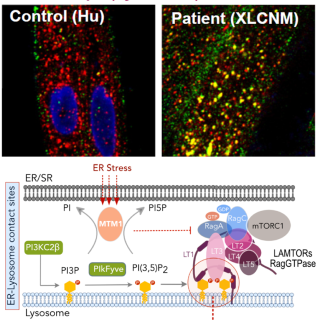
The study identifies lysosomal phosphoinositides as key upstream regulators of RagGTPase–mTORC1 signalling. The authors show that the lysosomal lipids PI3P and PI(3,5)P2 control the stability and dynamics of the LAMTOR–RagGTPase complex, uncovering an essential layer of metabolic regulation at the lysosome.
The work further demonstrates that MTM1, a phosphoinositide phosphatase mutated in myotubular myopathy, regulates these lipid pools through endoplasmic reticulum–lysosome contact sites. Under conditions of endoplasmic reticulum stress, this mechanism helps restrain mTORC1 activity and preserve the anabolic–catabolic balance required for proper myogenic differentiation.
Importantly, restoring mTORC1 activity or lysosomal phosphoinositide homeostasis was sufficient to improve muscle growth in cellular and mouse models of myopathy. These findings open new perspectives for understanding and potentially targeting lysosome-dependent nutrient signalling in muscle disorders.
Panasyuk lab is pleased to have been part of this important collaborative effort, which illustrates the value of combining complementary expertise to address fundamental questions in metabolism and muscle biology.
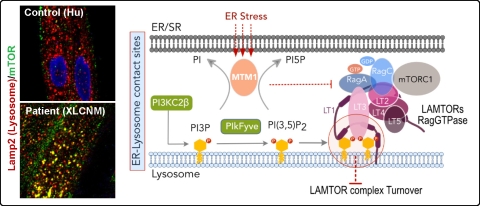
Image credit: Dr. K. Hnia