Manvendra SINGH - New team leader at INEM
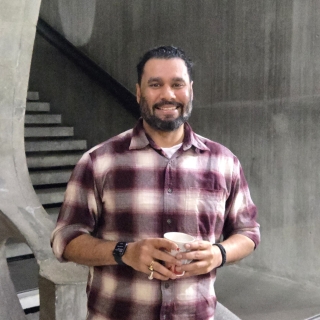
INEM has welcomed a new team leader at the start of 2026.
Manvendra SINGH - already quite established on the 6th floor of the Necker Institute with his freshly hired team members - is thrilled to present his own team called "RETROGEN" for RETROelements and GENome regulation.
As hinted by his team's name, Manvendra SINGH's research specialises in human endogenous retroviruses. In this interview, he shares with us his journey, his innovative research, and his vision of collaborative science.
** Could you tell us a bit about yourself and your journey to Institut Necker Enfants-Malades?
Manvendra SINGH: ** My path to scientific excellence began in challenging circumstances. Born in an infrastructure-wise underprivileged but a beautiful Indian city where daily life often ran on only a few precious hours of electricity, I completed my secondary education locally before pursuing higher studies through India's competitive university system. After successfully navigating these selection processes, I earned my bachelor's and master's education from one of India's most prestigious institutions (UP college, Varanasi, Bundelkhand University, Jhansi and Jawaharlal Nehru University, New Delhi).
Driven by aspirations for doctoral excellence, I went on a three-year journey as a pre-graduate research scholar in Center for Cellular and Molecular Biology, Hyderabad. It was there that I developed a deep passion for genetics, working on both ancient and modern DNA. A defining moment came when our team solved the mystery of Queen Catherine of Georgia's remains. Through meticulous DNA extraction and global genetic matching, we confirmed the identity of these historical bones. This discovery, uncovering something that had waited centuries to be found had crystallized my commitment to spend my life uncovering nature’s hidden stories.
My scientific journey then took me to the Max Delbrück Center in Berlin for PhD with Professor Zsuzsanna Izsvák (Zsuzsa), whose pioneering vision in transposable elements and genome engineering has set premise for a plenty of great discoveries in gene therapy field. Later, as a Presidential post-doc fellow at Cornell University, I got an opportunity to work with Professor Cédric Feschotte (Cedric), one of the world leaders in transposon biology and his training is the reason why I am here. Both mentors not only honed my skills but also instilled in me the courage to ask ambitious, high-impact questions.
** What is your current research focus? And how would you explain it to somebody who's totally out of your field?
Manvendra SINGH: ** My research does focus on virus-like sequences embedded within human DNA which is a fascinating legacy of our evolutionary history. These sequences originated from viral attacks on our ancestors over 100 million years ago. Remarkably, every human being carries identical viral sequences, suggesting that only those ancestors who survived these infections with viruses becoming integrated into their DNA has successfully passed on their genetic material.
Briefly, I current study how these ancient viruses are awaken under stress like hypoxia, shape the brain and immune system, and could hold the key to preventing diseases from dementia to long COVID.
My work investigates why these ancient viruses (Human endogenous retroviruses (HERVs) activate in various human diseases, including neurodegenerative conditions, cancers, and pregnancy-related disorders.
We’ve also found that HERVs can act as molecular allies, joining our immune system in battles against external infections such as HIV or Epstein–Barr virus. Environmental stressors like hypoxia - when tissues are starved of oxygen -appear to shift how these viral elements behave, sometimes tipping the balance toward inflammation in the brain or immune system. By mapping HERV activity across every human cell type and understanding how stressors rewire them, my goal is to uncover new ways to protect brain health, strengthen immunity, and prevent diseases that currently have no cure. I aim to uncover additional mysteries surrounding these viral relationships, leveraging Necker campus’s exceptional resources, sample collections, and collaborative networks.
** What has been the most defining moment in your scientific career so far?
Manvendra SINGH: ** While the activation of HERVs represents pathological dysregulation, we've discovered something extraordinary: pluripotent embryonic cells, the foundational cells that develop into complete human beings cannot survive without these viral sequences. Their removal results in cell death, revealing our fundamental biological dependence on these ancient viral partners.
The discovery that retroviruses-derived sequences in our DNA are absolutely essential for embryonic cell survival represents the defining moment of my career. This finding fundamentally transformed our understanding of being human, as we are a part human and part viruses.
** What specifically attracted you to Necker Campus and what made you choose us over other opportunities?
Manvendra SINGH: ** The decision was compelling for several reasons. Beyond an excellent environment and infrastructure, the remarkable biocluster within a half-mile radius encompassing Imagine, INEM, Curie and Pasteur creates an unparalleled scientific ecosystem. This concentration brings together researchers whose work has shaped my intellectual development and continues to inspire my scientific journey.
The combination of exceptional group leaders established research programs, extensive sample cohorts, and collaborative infrastructure creates an environment of unprecedented opportunity. Paris's central location adds another dimension to this appeal as the key retroviruses research groups in this part of world are just few hours away by train e.g., London, Lausanne, Frankfurt, etc., which I think will greatly help me in building consortiums and Collaboratory frameworks. This convergence of professional excellence and quality of life represents what I consider the optimal research environment, supporting both ambitious scientific goals and personal well-being. Most importantly, it offers the independence and intellectual freedom that drives meaningful discovery, which remains one of my priorities.
** If you could solve one major challenge in genetic diseases, what would it be and why?
Manvendra SINGH: ** There is not a single genetic disease that we want to see as a challenge. We aim for broader mechanisms. Genetic diseases often involve undocumented mechanisms that deviate from conventional biological processes. These conditions typically arise from accidental mutations or post-transcriptional aberrations i.e., small molecular accidents that can produce significant phenotypic consequences. When it comes to re-writing the rules of biology, genomic elements like transposons and endogenous retroviruses are involved in driving it; albeit not fully explored yet.
My primary interest lies in developing comprehensive therapeutic solutions rather than merely diagnostic tools. This approach would advance personalized medicine through artificial intelligence applications, leveraging the massive human genetic databases now available. By understanding these rare disease mechanisms, we can potentially prevent or treat conditions that currently have limited therapeutic options.
** Where do you see your research making the biggest impact in the next five years and how would it benefit patients and their families?
Manvendra SINGH: ** My research addresses an emerging but critical health challenge: past viral infections or other encounters that activate endogenous retroviruses which in turn, predispose individuals to future neurological diseases. My expertise in human endogenous retroviruses, supported by robust experimental data derived from patients materials, demonstrates that viral activation leads to retroviral circulation in the bloodstream. These circulating retroviruses can, when the blood-brain barrier becomes more permeable, slip into the brain and ignite inflammation and neurodegeneration.
Within five years, I aim to map the ‘dark matter’ of our genome – HERVs through the first Human Cell Atlas of ERVs, revealing how they drive rare and complex diseases. By decoding these hidden mechanisms, I aim to develop small molecule therapeutics capable of silencing these retroviruses, thereby preventing neurological disease onset. This work has immediate relevance to current health challenges such as long COVID that represents merely the beginning of this phenomenon.
** What excites you the most about the collaborative environment at Necker campus and are there any specific teams or projects here that you're eager to work with?
Manvendra SINGH: ** The collaborative potential here is extraordinary. During my interview process, I identified at least ten group leaders whose research directly complements my work. At INEM, I have already initiated informal collaborations that show a good promise.
I see natural synergies with Michela Deleidi’s work on neurodegeneration, Marco and Mahevas on immune responses, Fabiola and Nicolas Venteclef on metabolic–immune crosstalk, Laurence Arbibe on Inflammation and ageing and Mickaël Manach and Annarita Miccio on gene and cell therapies. These, combined with Antonio Rausell’s AI-driven bioinformatics, align perfectly with my focus on hypoxia, HERVs, and disease mechanisms are opening the door to discoveries none of us could achieve alone. These existing connections, combined with the institute's collaborative culture, create an environment where interdisciplinary breakthroughs become possible.
** What first sparked your interest in science and was there a particular moment or person who inspired you?
Manvendra SINGH: ** My interest in science wasn’t a sudden spark. My scientific awakening occurred through mentorship with a prominent figure in Indian science the legendary Prof. Lalji Singh, a pioneer of Indian science who unraveled many molecular mysteries of human origins in the Indian subcontinent. At that stage, I was still absorbing knowledge, not yet generating original ideas. The real transformation came later, training with Zsuzsa and Cedric where I learned how to think like a detective, spotting hidden clues in the genome. From Cédric, I learned how to present those discoveries like a lawyer building a compelling, evidence-driven case. That combination of curiosity, strategy, and storytelling was electrifying, and it turned science from a profession into a lifelong thriller. I discovered that scientists are essentially paid to pursue their passion for learning and even reading a realization that profoundly shaped my career choice.
This passion developed gradually, evolving into what I describe as a Sherlock Holmes mentality. I experience genuine distress when not learning something new or solving complex puzzles. Each day begins with the goal of discovering knowledge that doesn't yet exist in accessible forms. Research uniquely satisfies this intellectual hunger. When colleagues ask about the difficulty of doctoral studies, I describe it as a “paid research vacation!”. This passion explains my commitment to academia over industry, as it provides the freedom to explore, make mistakes, and pursue the unknown.
** How do you stay motivated when research gets challenging or results don't come as quickly as expected?
Manvendra SINGH: ** My motivation stems from an unshakeable conviction that setbacks are temporary rather than terminal. Fifteen years in research have taught me that challenges, failures, and unexpected results are integral to the scientific process. While immediate validation may be elusive, persistence ultimately yields results.
This perspective transforms obstacles into learning opportunities rather than sources of discouragement. Patience and persistence remain the researcher's most valuable tools.
** Outside of the lab, what do you enjoy doing? How do you recharge?
Manvendra SINGH: ** My background as a professional cricket player significantly influences my approach to both research and life. Cricket's extended format where matches lasting up to five days teaches strategic thinking about when to press forward and when to hold back. It also trains you to stay calm and let things go when the opponent is dominating-a perfect metaphor for handling negative results in science-while allowing you to read the situation, adapt, and stage a strong comeback when conditions turn in your favor. This sport demands not just physical fitness and intelligence, but also sophisticated game management skills.
These lessons translate directly to research, where knowing when to pursue provocative hypotheses and when to exercise patience proves invaluable. Cricket built my resilience and strategic thinking capabilities that keep on serving me well in scientific endeavours.
**If you could have dinner with any scientist, living or dead, who would it be and why?
Manvendra SINGH: ** Among those who are not among us, I would have liked to dine with Barbara McClintock and talk about all her success stories while bringing genomic transposons from “dark” to “light”. Regarding intellectual inspiration, I would choose to dine with Cedric Feschotte, an extraordinary scientist whose childlike curiosity and energy despite his senior status continues to inspire me. His ability to immediately engage with new discoveries and transform them into research puzzles represents the scientific spirit at its finest. Conversations with him, perhaps alongside Lawrence D. Hurst from the University of Bath, would be a great retreat where I would only like to listen to them talking.
** If you had to describe your research philosophy in one sentence, what would it be?
Manvendra SINGH: ** “Every human that is surviving today represents a success story, every retrovirus that is alive today represents a success story, and they have achieved this success together.”
** What message would you like to share with our community here ?
Manvendra SINGH: ** I am profoundly excited to join these exceptional teams and contribute to our collective scientific mission. My focus on AI and computational biology thrives on extensive collaboration with experimental scientists, making this journey inherently collaborative. Together, we can tackle scientific challenges that individual lab or a single brain could not solve them alone.