New publication from Terzi lab in JCI
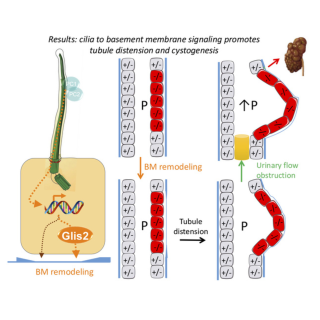
Cilia to basement membrane signaling is a biomechanical driver in models of autosomal dominant polycystic kidney disease
The Journal of Clinical Investigation – June 30, 2026
The Mechanisms and Therapeutic Strategies of Chronic Kidney Disease team, led by Fabiola Terzi at INEM, in collaboration with the Imagine Institute and several national and international partners, has identified a novel biomechanical mechanism involved in cyst formation in autosomal dominant polycystic kidney disease (ADPKD). In this study, published in the Journal of Clinical Investigation (JCI), Manal Mazloum, Frank Bienaimé, and their colleagues demonstrate that primary cilia regulate remodeling of the tubular basement membrane (TBM), a key process in the initiation of cystogenesis.
ADPKD is the most common inherited kidney disease. It is characterized by the progressive development of fluid-filled cysts arising from the renal tubules, whose expansion gradually impairs kidney function. It is currently the fourth leading cause of end-stage kidney disease worldwide. The only approved treatment provides only a modest slowing of cyst growth and kidney function decline and is associated with significant side effects.
ADPKD is primarily caused by loss-of-function mutations in the PKD1 gene, encoding polycystin-1 (PC1). PC1 is localized to the surface of the primary cilium, a hair-like sensory organelle that protrudes into the lumen of the renal tubules from the apical surface of tubular epithelial cells. In the absence of PC1, a primary cilium-dependent signaling cascade triggers cyst formation. However, the nature of this signaling pathway and the molecular mediators involved remain undetermined.
Using a combination of complementary experimental models, the researchers show that loss of Pkd1 induces a cilia-dependent remodeling of the tubular basement membrane. This remodeling is characterized by thinning of the basement membrane and a selective enrichment in heparan sulfate chains. These changes alter the biomechanical properties of the renal tubules, promoting tubular dilation and the initiation of cyst formation. The study also demonstrates that this basement membrane remodeling is transcriptionally regulated by the transcription factor GLIS2, which has previously been identified as a key regulator of pro-cystogenic ciliary signaling.
Together, these findings establish a new biomechanical model of cystogenesis in ADPKD, in which the primary cilium drives tubular basement membrane remodeling to alter the mechanical properties of the renal tubule. They also provide new insights into the molecular mediators of ciliary signaling and identify potential therapeutic targets for the treatment of ADPKD.