New publication from Singh lab in Genome Biology
Ancient Viral DNA Controls Genes Linked to Pre‑Eclampsia
Genome Biology, March 9, 2026, Paris.
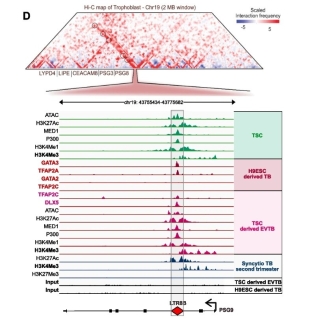
Manvendra Singh, newly appointed team leader of the RETROGEN team at INEM arrives with stricking new scientific results. Along with collaborators from the Max Delbrück Center, Cornell University, and the University of Bath, they have unraveled the molecular mechanism by which ancient viral DNA controls genes associated with pre‑eclampsia, a serious pregnancy complication. The study appears today in Genome Biology.
🔗 Click here to access the article
Key Findings
- LTR8B, an endogenous retroviral element, acts as a regulatory switch. The team identified LTR8B as a cis‑regulatory element within the pregnancy‑specific glycoprotein (PSG) gene cluster. Positioned at the PSG9 locus, LTR8B “rewires” gene expression and influences other PSG family members. Removing a single copy of LTR8B collapsed expression of the entire PSG array and disrupted placental cell differentiation.
- MER65 provides alternative polyadenylation signals. A second retroelement, MER65, supplies alternative poly(A) signals that generate secreted PSG protein variants. These variants circulate in the mother’s blood and can be measured with standard assays.
- Implications for pre‑eclampsia. Pre‑eclampsia affects roughly 3–8 % of pregnancies worldwide and remains a leading cause of maternal and neonatal morbidity. PSG9 is the most up‑regulated PSG gene in pre‑eclampsia, with levels correlating to dysregulation of transcription factors GATA3 and DLX5. By linking viral regulatory elements to PSG gene expression, the study points to PSG9 as a potential early biomarker for pre‑eclampsia.
Discussion with the authors
“An ancient viral sequence can act like a manual for a placental gene,” explains Dr. Manvendra Singh, lead author and director of the newly established RETROGEN lab at INEM. “Our study shows how retroviral elements, once considered genomic ‘junk,’ now play an essential role in placental development and may provide an avenue for earlier diagnosis of pre‑eclampsia.”
Professor Zsuzsanna Izsvák of the Max Delbrück Center adds: “Moving from genome‑wide predictions to functional tests allowed us to demonstrate that LTR8B and MER65 are central to controlling PSG gene expression. These findings highlight the importance of retroviral elements in human evolution and disease.”
Professor Laurence Hurst of the University of Bath, co‑corresponding author, underscores the clinical impact: “Pre‑eclampsia is a dangerous and surprisingly common complication of pregnancy. By understanding how viral DNA controls placental genes, we can begin to develop tools for early detection and intervention.”
Looking Ahead
The team is now collaborating with Professor Sandra Blois at University Medical Center Hamburg‑Eppendorf to evaluate PSG9 as a biomarker in larger pregnancy cohorts. Future studies in collaboration with Cedric Feschotte, Heidi Stuhlmann and Robert Schwartz will explore whether similar retroviral circuits might help stratify risk or identify therapeutic targets for placental disorders.
For more information, contact:
Dr Manvendra Singh
Research Director, RETROGEN team
INEM – Institut Necker Enfants Malades
manvendra.singh@inserm.fr