Diabetes Research at INEM
World Diabetes Day is observed on November 14 each year. This is an opportunity for INEM to highlight the research being conducted on various types of diabetes at our institute.
What Is Diabetes?
Diabetes is a disorder affecting the absorption, use, and storage of sugars from food. This results in high blood glucose levels, known as hyperglycemia.
In a healthy person, blood glucose levels range from 0.70 to 1.10 g/L. During and after meals, blood glucose levels rise, triggering the secretion of insulin, which helps normalize blood glucose levels. Insulin allows glucose to enter the body’s cells. Some of the glucose from food is then stored in the liver and muscles. When fasting or between meals, blood glucose levels tend to drop. Another hormone, glucagon, then triggers the release of glucose stored in the liver to normalize blood glucose levels.
In diabetes, this regulatory system is disrupted.
The Two Main Types of Diabetes
- Type 1 Diabetes
In type 1 diabetes, the pancreas no longer produces enough insulin. Without it, cells can no longer properly use the sugar circulating in the blood. Hyperglycemia develops rapidly as soon as insulin levels become insufficient.
- Type 2 diabetes
Type 2 diabetes develops over several years in three stages:
- First, the body’s cells become resistant to insulin. This resistance is normal with age but is exacerbated by excess body fat in cases of overweight and obesity. This stage is called insulin resistance. Glucose accumulates in the blood, and hyperglycemia gradually sets in;
- The body tries to adapt. Initially, the pancreas increases insulin production: this is called hyperinsulinism;
- After several years (10 to 20 years), the pancreas becomes exhausted and can no longer secrete enough insulin to regulate blood sugar levels: this is the stage of insulin deficiency.
Diabetes Research at INEM
At INEM, several teams are involved in diabetes research:
- The IMMEDIAB team (Immunity and Metabolism in Diabetes), led by Nicolas Venteclef;
- The Immunity in Health and Disease team, led by Simon Fillatreau.
Although their research topics are distinct, they share a common goal: to better understand the mechanisms of immune regulation, identify the processes involved in the development of diseases, and open up new therapeutic avenues.
IMMEDIAB, Immunity and Metabolism of Diabetes
A pioneer in the field of immunometabolism, the IMMEDIAB team studies the interactions between the immune system and metabolism, taking into account the influence of environmental factors. Its goal is to understand how these interactions contribute to maintaining metabolic balance and how their dysregulation can promote the development of diseases, particularly diabetes.
Identifying at-risk patients based on their inflammatory profile
Low-grade chronic inflammation, also known as meta-inflammation, plays a major role in the development of complications from type 2 diabetes. It is notably associated with an increased risk of cardiovascular and renal complications.
Research by Prof. Louis Potier, along with Dr. Bao Tran Vuong and Dr. Chloé Delépine, highlights the value of patients’ immune profiles in better assessing these risks. By analyzing parameters from a routine blood test, the complete blood count (CBC), levels of neutrophils, lymphocytes, and monocytes, the researchers identified four distinct inflammatory profiles in people living with type 2 diabetes (Vuong B et al. Cell Metabolism 2026).
These profiles make it possible to distinguish different levels of inflammation as early as the time of diagnosis. One of these profiles, characterized in particular by high monocyte levels, is associated with a significant risk of cardiovascular disease, chronic kidney disease, and premature death.
This approach could lead to the development of a simple tool for assessing individual risk based on readily available biological data. It also opens up possibilities for more personalized care, taking into account each patient’s inflammatory profile.
In line with this, the team is also evaluating a new therapeutic approach: dapansutrile, a molecule that inhibits the NLRP3 inflammasome, which is involved in triggering inflammation. This evaluation is part of the European INTERCEPT-DT2 project, coordinated by Dr. Nicolas Venteclef.
Better Anticipating Liver Complications of Diabetes
The liver is another major focus of research conducted by IMMEDIAB. People living with type 2 diabetes are at high risk of developing NAFLD, a liver disease associated with metabolic dysfunction. This condition can progress silently for several years and lead to severe complications, such as advanced fibrosis, cirrhosis, or liver cancer.
The QUID-NASH Follow-Up project, to which Professor Jean-François Gautier is contributing, aims to better understand the progression of this disease in diabetic patients.
The study involves following patients for more than five years to identify the biological factors associated with the progression of liver damage and to pinpoint reliable predictive markers. Researchers are conducting biological analyses, medical imaging, FibroScan tests, and characterization of mmune-inflammatory profiles.
A central hypothesis of the project is that patients with severe liver damage may have a specific immune profile, characterized by an increase in circulating inflammatory monocytes and macrophages in liver tissue.
The goal is to better identify patients at risk of developing the most severe forms of the disease and to develop more accessible monitoring tools to improve their care.
This research is part of a collaborative effort led by the DiabetEX program, coordinated by Dr. Nicolas Venteclef. This consortium brings together some twenty basic and clinical research teams, patient associations, industrial partners, and international collaborators around a common goal: to better understand diabetes, its progression, and its complications, and to identify new therapeutic targets.
Immunity in Health and Disease
The Immunity in Health and Disease team explores another aspect of diabetes: the regulation of immune responses.
The team studies the role of B and T cells in autoimmune and infectious diseases, with a particular focus on pro-inflammatory and anti-inflammatory immune cell subpopulations.
The balance between different immune responses is essential for protecting the body against infections while preventing reactions directed against its own tissues. The researchers are particularly interested in regulatory T cells (Tregs) and B cells, which help maintain this balance.
This research is of particular interest for type 1 diabetes, in which immune regulatory mechanisms represent an important avenue for therapeutic research.
Regulatory T Cells at the Heart of a New Therapeutic Approach
Tregs cells play an essential role in controlling immune responses. In particular, the team has shown that the receptors of autoreactive Tregs possess specific high-affinity antigen-recognition properties, which are critical for their protective functions against immune-mediated diseases.
The current goal is to translate these findings to human diseases, starting with type 1 diabetes, through the development of human Tregs cells expressing autoreactive TCR receptors.
This strategy is being developed as part of the European ARTiDe project (Autoantigen-specific adoptive regulatory T cell therapy against type 1 diabetes), under the coordination of Prof. Simon Fillatreau.
Bringing together academic, clinical, and industrial partners, the project aims to develop a cell therapy approach based on genetically modified Tregs cells.
The objectives are to identify and select suitable TCRs, evaluate the safety and efficacy of these cells in preclinical models, and develop a production process that complies with pharmaceutical manufacturing standards.
Antimicrobial Peptides: A New Area of Research
Research by Dr. Julien Diana’s team also focuses on the role of antimicrobial peptides (AMPs) in the development of type 1 diabetes, particularly in relation to the gut microbiota.
The research has shown that AMPs have several protective functions:
- They contribute to the establishment of a protective gut microbiota during the perinatal period;
- When expressed by pancreatic beta cells, they help regulate the immune system locally within the pancreatic islets;
- They also stimulate the endocrine function of beta cells through an autocrine action.
These findings highlight the importance of interactions between the gut microbiota, the immune system, and pancreatic cells in the mechanisms associated with type 1 diabetes.
To learn more about antimicrobial peptides:
Two teams, one shared goal: advancing diabetes research
By studying diabetes from complementary perspectives, the IMMEDIAB and Normal and Pathological Immunity teams are helping to advance our understanding of the immune mechanisms involved in this disease.
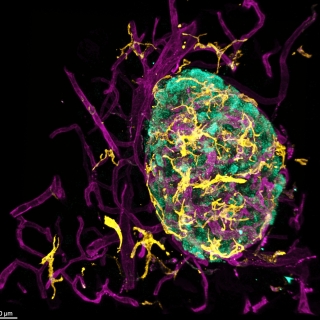
Image by Claire Leveau, a postdoctoral researcher in Nicolas Venteclef’s team. Insulin (green), lectin for blood vessels (purple) and macrophages (gold).