Chrysostomou E. and colleagues from Mourikis lab report a new mechanism that maintains muscle stem cell quiescence
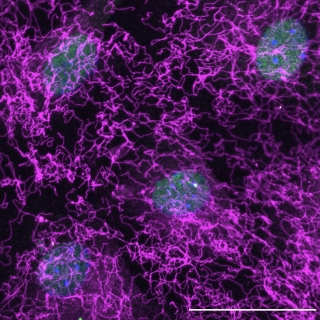
Muscle stem cells produce a protective Fibrillin- 1 matrix to prevent precocious activation
Science Advances – October 2026
The Muscle Stem Cells-Niche Interactions team, headed by Philippos Mourikis, reports a new insight in quiescence preserving mechanism in muscle stem cells and position stem cell dysfunction as a driver of Marfan syndrome (MFS) myopathy. In this study, published in Science Advances, the lab investigates the matrix glycoprotein Fibrillin-1 (FBN1) role in muscle stem cell (satellite cells) quiescence.
The niche of muscle stem cells provides cues that preserve stem cell quiescence. Among the regulators of quiescence is the Notch signalling pathway. Moreover, FBN1 is a large extracellular protein and mutations in FBN1 underlie MFS.
Using human muscle biopsies, immunofluorescence and mouse models, among other techniques, this works demonstrates that FBN1 is a target of Notch signalling in muscle stem cells and is essential for maintaining quiescence in those cells. Furthermore, decrease in FBN1 activates TGFβ signalling in muscle stem cells and interrupt quiescence projections. Finally using losartan, a widely prescribed drug that inhibits TGFβ, in FBN1-deficient satellite cells, restores quiescence and prevents muscle performance decline.
These findings offer a new quiescence preserving mechanism in muscle stem cells: FBN1 is a critical component of stem cells niche and protects satellite cells from aberrant growth factor signalling. In MFS, abnormally satellite cells have been identified and those results position stem cells dysfunction as a driver of MFS.