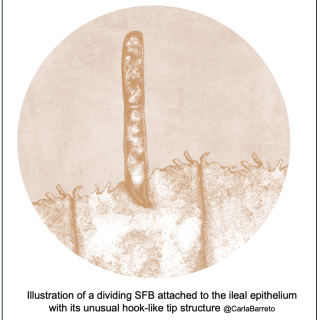
Segmented filamentous bacteria are worldwide human gut commensals
Nature Communications - 05 March 2026
The Host-Microbiota Interaction lab, headed by Pamela Schnupf, has discovered, in collaboration with researchers at the Institut Pasteur, Institut Imagine, the University of Maryland and GEMS investigators, a gut commensal bacterium in humans of the Segmented filamentous bacteria (SFB) clade and identified a surprising diversity of SFB in humans on a global scale.
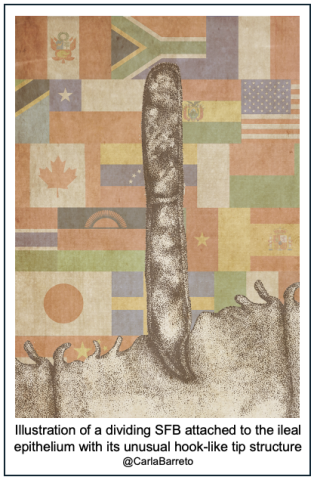
In mice, the mouse SFB species is a critical bacterium in both health and disease due to its potent immunostimulatory potential mediated by its intimate attachment to the ileum. In this study, published in Nature Communications, postdoctoral fellows Shashi Kiran and Ana Raquel Cruz identify and characterise a new bacterial species, named Anisomitus miae, in the gut microbiota of Malian children and establish this species as the nomenclature type for the SFB genus. This species has the SFB-specific morphology and genome composition but includes previously unknown genome features such as a starch and glycogen degradation uptake module that is able to bind a range of maltooligosaccharides. Through bioinformatic analysis of both metagenomic data and 16S rRNA gene amplicon data, the A. miae lineage was found to be common in Africa, including in indigenous cultures, suggesting their ancient association with humans. Bioinformatic identification of SFB, based on its 16S rRNA gene V3-V4 region, furthermore identified a total of four major and at least two minor SFB lineages worldwide, in 44 countries and all inhabited continents. The A. miae lineage was also found to have colonisation dynamics similar to SFB in mice with a short but potent colonisation peak during early childhood and otherwise a very low relative abundance.
This study establishes the existence of an SFB species with SFB-specific morphology and genome sequence in humans, the presence of at least six human SFB lineages in the human population, the official name of the SFB genus, and it provides evidence towards SFB being likely prevalent albeit minor members of the gut microbiome in humans.
Find the article here: https://doi.org/10.1038/s41467-026-70010-4
PDF : https://rdcu.be/fjwGN