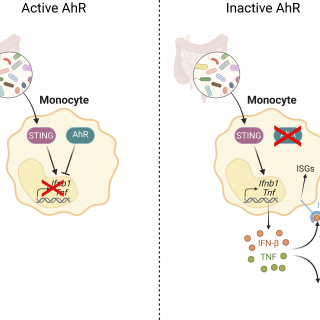
Inhibition of microbial sensing by AHR in monocytes: a mechanism that restrains cytokine responses
The group led by Élodie Segura, within the Immune Response and Danger Signals team directed by Bénédicte Manoury (INEM), together with collaborators at the Baylor Institute for Immunology Research (Dallas, USA) and the Institute of Experimental Immunology at the University of Zurich (Zurich, Switzerland), sheds new light on the mechanisms that allow the immune system to control the constant stimulation induced by microbiota-derived signals.
Initiated at Institut Curie and completed after the group relocated to INEM, this work led by Adeline Cros and Alessandra Rigamonti (co-first authors), demonstrates that the absence of the Aryl Hydrocarbon Receptor (AhR) in monocytes triggers spontaneous cytokine responses in vivo. This deregulation results from the activation of the STING pathway in response to the microbiota, revealing the essential role of AhR in modulating monocyte responses to microbial sensing. Notably, this effect is strictly monocyte-specific: mice lacking AhR exclusively in macrophages show no alteration in cytokine responses.
The study further shows that pharmacological inhibition of AhR increases cytokine responses in human monocytes, highlighting the evolutionary conservation of this regulatory mechanism. Finally, in patients with systemic juvenile idiopathic arthritis, low AhR activity in monocytes correlates with elevated cytokine production, highlighting the clinical relevance of these findings.
Together, these results identify AhR as a crucial regulator in monocytes, restraining immune activation triggered by microbiota sensing and thereby maintaining immune homeostasis.