New publication from Goffin lab in EMBO Molecular Medicine
Targeting pre-existing club-like cells potentiates androgen deprivation therapy in prostate cancer
EMBO Molecular Medicine, February 2026
Researchers from the Prolactin and Growth Hormone Pathophysiology laboratory, directed by Vincent Goffin, in collaboration with several national and international partners, report a novel therapeutic strategy to limit prostate cancer progression toward castration-resistant disease. In a study recently published in EMBO Molecular Medicine, Manon Baurès and Anne-Sophie Vieira Aleixo (co-first authors, graduated and current PhD students at INEM), together with Vincent Goffin and colleagues, investigate the role of a specific tumour cell population in resistance to androgen deprivation therapy (ADT).
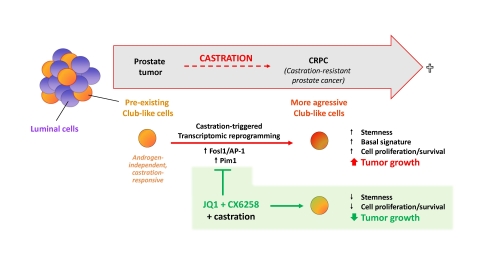
Androgen deprivation therapy remains a cornerstone of prostate cancer treatment. However, most tumours eventually relapse and progress toward castration-resistant prostate cancer (CRPC), a lethal stage of the disease. The cellular mechanisms underlying this transition remain not completely understood. In this work, the authors focus on a population of pre-existing club-like epithelial cells present within prostate tumours prior to treatment.
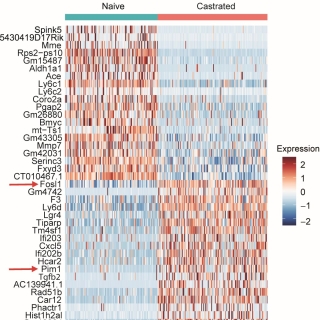
Using a combination of a prostate-specific Pten-deficient mouse model combined with single-cell RNA sequencing, the study demonstrates that these club-like cells survive despite androgen deprivation and contribute to tumour persistence and progression. More precisely, the club-like progenitor cells present in treatment-naïve tumors acquire castration tolerance through major transcriptional reprogramming, rather than through intrinsic resistance mechanisms. This reprogramming is associated with increased cellular plasticity and aggressive tumor features and is driven by the transcription factor FOSL1/AP-1.
Importantly, selective targeting of this cell population by dual pharmacological targeting of FOSL1/AP-1 and PIM kinases suppresses progenitor properties and significantly reduces tumor growth in both mouse and human models, and overall significantly enhances the efficacy of ADT, delaying tumour relapse and limiting progression toward castration-resistant disease.
By identifying pre-existing club-like cells as a critical reservoir of resistance, this study provides new insight into prostate cancer cell plasticity and highlights a previously unrecognized therapeutic vulnerability. These findings suggest that combining androgen deprivation therapy with strategies targeting resistant tumour cell subpopulations, such as the club-like cells studied here, could improve long-term disease control in prostate cancer patients.
🔗 Click here to access the article
Images credits: Baurès M, Vieira Aleixo AS, et al. Targeting pre-existing club-like cells in prostate cancer potentiates androgen deprivation therapy. EMBO Mol Med. 2026 Feb 2. doi: 10.1038/s44321-026-00375-y.