New publication from Veronique Baud group in Cell Death & Disease
The alternative NF-κB RelB subunit is a novel critical sensor of lipid metabolism to promote tumor development
Cell Death & Disease – July 4, 2026
The group led by Véronique Baud focusing on the research axis “NF-kB, Metabolism, Immunity and Cancer” in the Cell Growth Control by Nutrients team, led by Mario Pende at INEM, uncovered that RelB, the alternative NF-kB subunit, acts as a central homeostasis sensor of lipid metabolism in cancer cells.
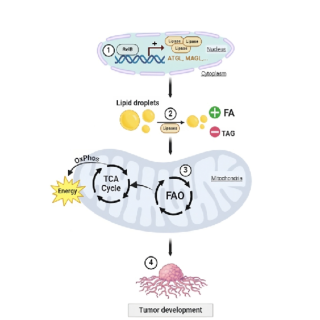
In this study, published in Cell death & Disease, Véronique Baud and colleagues, in collaboration with national partners, demonstrate that RelB plays a central role at the crossroad of lipid storage and liberation of free fatty acids from the lipid droplets to feed the fatty acid oxidation (FAO) for mitochondrial activity and energy production to promote tumor development.
Cancer cells have high energy needs leading to rapid growth, invasion and migration of tumours. To meet those needs, reprogramming of lipid metabolism is a typical feature in cancerous cells. Understanding this reprogramming is crucial to understand cancer development.
In this study, the authors show that the alternative subunit of NF-kB, RelB, drives the transcription of major lipolytic lipases, including Adipose Triglyceride Lipase (ATGL) and Monoglyceride Lipase (MAGL) in HCC cells. Those lipases act as regulator for the release of fatty acids (FA) from stored triacylglycerols (TAG) in lipid droplets, the so-called lipolysis.
The study identifies that the RelB-dependent increase in lipolysis drives cancer cells to increase FAO to feed the mitochondrial energetic metabolism. The RelB-dependent rewiring of lipid metabolism towards FAO promotes hepatocellular carcinoma (HCC) cells survival, migration and tumor development.
In HCC patient samples, the study also demonstrates that RelB positivity is associated with high protein expression of ATGL and low lipid droplets.
Together, these findings establish a new role for RelB, the alternative NF-kB subunit, in lipid metabolism in cancer cells, and provide a strong rationale for the development of new molecules targeting RelB for therapeutic intervention in cancer.
Beyond HCC, abnormal RelB activity has been reported in several solid cancers and hematopoietic malignancies. Thus, it is likely that the RelB-dependent lipid/FA dynamics and associated pro-survival and tumorigenic effects may be generalized to other neoplasms, especially those addicted to alternative NF-kB.