Mathieu Deygas and colleagues from Vargas’ team discovered how adaptative motility enables neutrophils to rapidly navigate confined capillaries
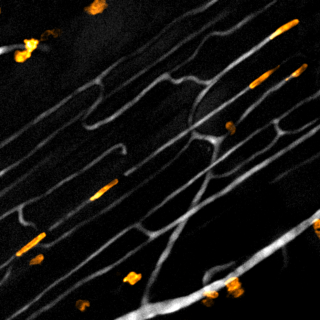
Adaptive motility enables neutrophils to rapidly navigate confined capillaries
Science Immunology – September 4, 2026
Mathieu Deygas and the Leukomotion Lab, headed by Pablo Vargas, reports how neutrophils maintain high migration speed in micrometric capillaries. In this study, published in Science Immunology, the team, took advantage of capillary-on-chip microdevices to investigate the role of actomyosin remodelling in neutrophil deformation and migration under strong confinement.
To reach sites of inflammation, neutrophils must migrate through thin and confined capillaries without damaging capillaries or blocking blood flow. In this study, the authors worked on how neutrophils undergo this rapid migration.
Using a combination of intravital live-cell imaging and biomimetic microfabricated capillaries, this work demonstrates that while confinement increases, neutrophils maintain their migration speed in capillaries and that, in response to changes in confinement, they reorganize their actin cytoskeleton. Furthermore, the authors identified the Rho/Myosin II pathway as a regulator of neutrophils migration adaptation to confinement strength and the kinase ROCK as an essential key in this migration.
Those findings reveal a new Rho/Myosin II dependent-mechanism making possible neutrophils migration through narrow capillaries, in vivo and in vitro. Neutrophils can reach confined vascular tissues without blocking blood flow.
This study was part of a close collaborative work with the group of Matthieu Piel at the Institut Curie!
The picture comes from intravital imaging (in vivo in mouse) and shows how neutrophils are deformed and elongated during their migration within capillaries.