New publication from Schnupf lab in Nature Communications
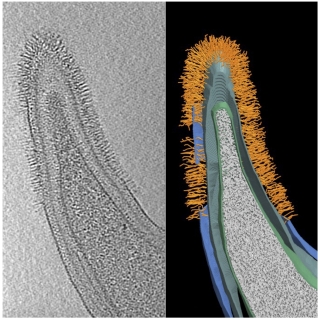
Segmented filamentous bacteria undergo a structural transition at their adhesive tip during unicellular to filament development
The Host-Microbiota Interaction lab, headed by Pamela Schnupf, has, in collaboration with researchers at the Institut Pasteur and the University of Zürich, discovered new insights into the life cycle of the still enigmatic gut commensal Segmented filamentous bacterium (SFB), a bacterium that is important for both health and disease due to its unusual immunostimulatory potential elicited through intimate binding to the host ileal epithelial surface.
In this study, recently published in Nature Communications, the authors identify a structural transition of the SFB surface during outgrowth of unicellular bacteria (called intracellular offsprings or IOS) into filaments and reveal that the adhesive nipple-like tip of the bacterium is a vulnerable site where a major Th17 and B cell antigen of SFB is immunologically accessible.
In this work, the first-author Ana Raquel Cruz (recent PhD graduate, now postdoc at GIMM Lisbon) uses cryo-electron microscopy and tomography to characterize the structural features of the SFB surface and particularly the unique nipple-like tip used for adhesion to intestinal epithelial cells in the ileum. The work identifies a repetitive S-layer surrounding IOs that becomes progressively replaced specifically at the IO tip by disordered hair-like structures that are consistent in location and timing with being involved in host cell attachment. Upon outgrowth into filaments, the bacterium then becomes fully surrounded by a morphologically distinct ordered hair-like layer (HLL) and this developmental transition, which can be divided into 5 separate stages, is conserved across SFB species.
The authors furthermore show that the developmental stages are perturbed when SFB grows in a heterologous host where attachment is not supported and that the major Th17 antigen is a ubiquitous cell wall-associated protein that is protected from immunological recognition by the S-layer and HLL but readily accessible to antibodies in filaments at the adhesive tip.
Together, this study sheds new insights into the intimate and critical interaction between SFB and its host.
🔗 Find the article here: https://www.nature.com/articles/s41467-025-66892-5
🔗 Find PDF here: https://rdcu.be/eX0MC