New publication from MEMBRAMICS lab in Nature Cell Biology
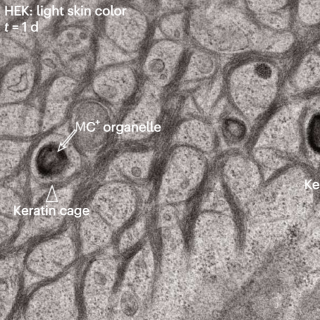
Keratin intermediate filaments mechanically position melanin pigments for genome photoprotection
The MEMBRAMICS team led by Étienne Morel (INEM), in collaboration with researchers from Institut Curie, Institut Pasteur, L’Oréal, IMRB and the MSC lab, reports new insights into the cellular mechanisms underlying genome photoprotection in human skin. In a study recently published in Nature Cell Biology, Cédric Delevoye (last author) and collaborators reveal how the skin cell cytoskeleton mechanically controls the positioning of melanin pigments to shield the cell’s genome from UV damage.
Initiated at Institut Curie and completed after the relocation of Cédric Delevoye and Laura Salavessa to INEM, this work was co-led by Silvia Benito-Martínez (co-first author, PhD) and Laura Salavessa (co-first author, postdoctoral researcher). Using - and characterizing - a physiologically relevant human keratinocyte model capable of internalizing extracellular melanin, the study demonstrates that keratin 5/14 intermediate filaments, together with microtubules, govern the three-dimensional perinuclear positioning of pigment organelles.
The authors show that keratin filaments form mechanical cages around pigment organelles, stiffening their microenvironment and maintaining their supranuclear localization on the sun-exposed side of the nucleus. This spatial organization relies on the coordinated interplay between intermediate filaments and microtubules, bridged by plectin cytolinkers, and is essential for optimal protection of genomic DNA against solar UV.
Through the identification of pigment organelle spatialization as a key biomechanical parameter of genome photoprotection, this study reveals that melanin-based UV protection is not only a biochemical matter but also mechanical in nature. Beyond addressing a long-standing question in skin and cell biology, the cellular model developed in this study provides the possibility to delve deeper into membrane dynamics and organelle positioning contribution to cellular responses to environmental stresses such as UV radiation.
🔗 Find the article here : https://doi.org/10.1038/s41556-025-01817-4
🔗 Full access here : https://rdcu.be/eUImp
Beyond the scientific results, this study reflects a long and collaborative research journey. We asked Laura Salavessa, co-first author and postdoctoral researcher in the MEMBRAMICS team, a few questions about the motivations, challenges and perspectives behind this work.
What was the appeal of this project for you?
One of the most exciting aspects of this project was how exploratory it was. Something I noticed, whenever I’m at a dinner or party and I have to explain my work to people outside of science: first, they are always engaged because skin pigmentation feels familiar, it’s visual, it takes place in a highly exposed organ, and we’re much more aware of it than many other physiological processes, besides there’s something sort of quirky about the exchange of melanin in skin [which occurs between cell types]. Second, people are always surprised to know how little we understand about certain parts of the process, especially given how aware we all are nowadays of the harmful effects of UV exposure.
Skin coloration and protection from solar radiation rely on a close interplay of two cell types: melanocytes, which produce and secrete melanin, and keratinocytes, which internalize these melanin pigments and maintain them above their nucleus, like a tiny sun umbrella. While we know quite a lot about how melanin is produced, what happens to it once it’s taken up by keratinocytes, how it’s maintained and how that contributes to its vital function of photoprotection remains quite obscure. That lack of information can be challenging when developing a project, but it also leaves plenty of room to be creative and to have fun – that freedom of scientific creativity in a rather unexplored topic was what I found most fascinating.
What was the main challenge in bringing this study together?
At the core this is a cell biology study, showing how the unique molecular signature of pigment organelles and their positioning allow them to be maintained and photoprotect keratinocytes’ genome. But the story tells us that melanin positioning is also a biomechanical process that can become relevant in disease.
Cytoskeletal elements, specifically keratin intermediate filaments and microtubules, work together to maintain the proper 3D position of pigment organelles, and we show that this positioning is essential for protection against UV-induced DNA damage. In certain skin disorders that affect keratin intermediate filaments (as in Dowling-Degos disease), pigment organelles become more dispersed, likely leaving keratinocytes more vulnerable to photodamage. Connecting organelle biology, cell biomechanics, and disease makes for a solid project but a very challenging one, and that’s where collaborations are essential. This was a long journey, starting at Institut Curie and finishing at INEM, with an equally long publication and review process, and involving many great scientists. I believe that its strong and trusting parternships made all the difference in keeping the project, and everyone’s motivation, moving forward.
How do you think this work will impact future research?
I think this work moves the field of skin biology and pigmentation forward by introducing new concepts and questions to explore – there is still a lot that remains unknown. One key contribution is the well-characterized human pigmented keratinocyte cellular model that reproduces essential aspects of pigmentation seen in vivo. This is a powerful tool to study pigment organelle biology, UV-induced stress responses, and skin physiology and pathology. In addition, and as a broader view, the melanin transfer system is a fantastic and highly tunable model that can be used to investigate cell-cell communication, the exchange of physiological particles, tissue homeostasis, stress responses, … It’s really a playground-model for future research.